
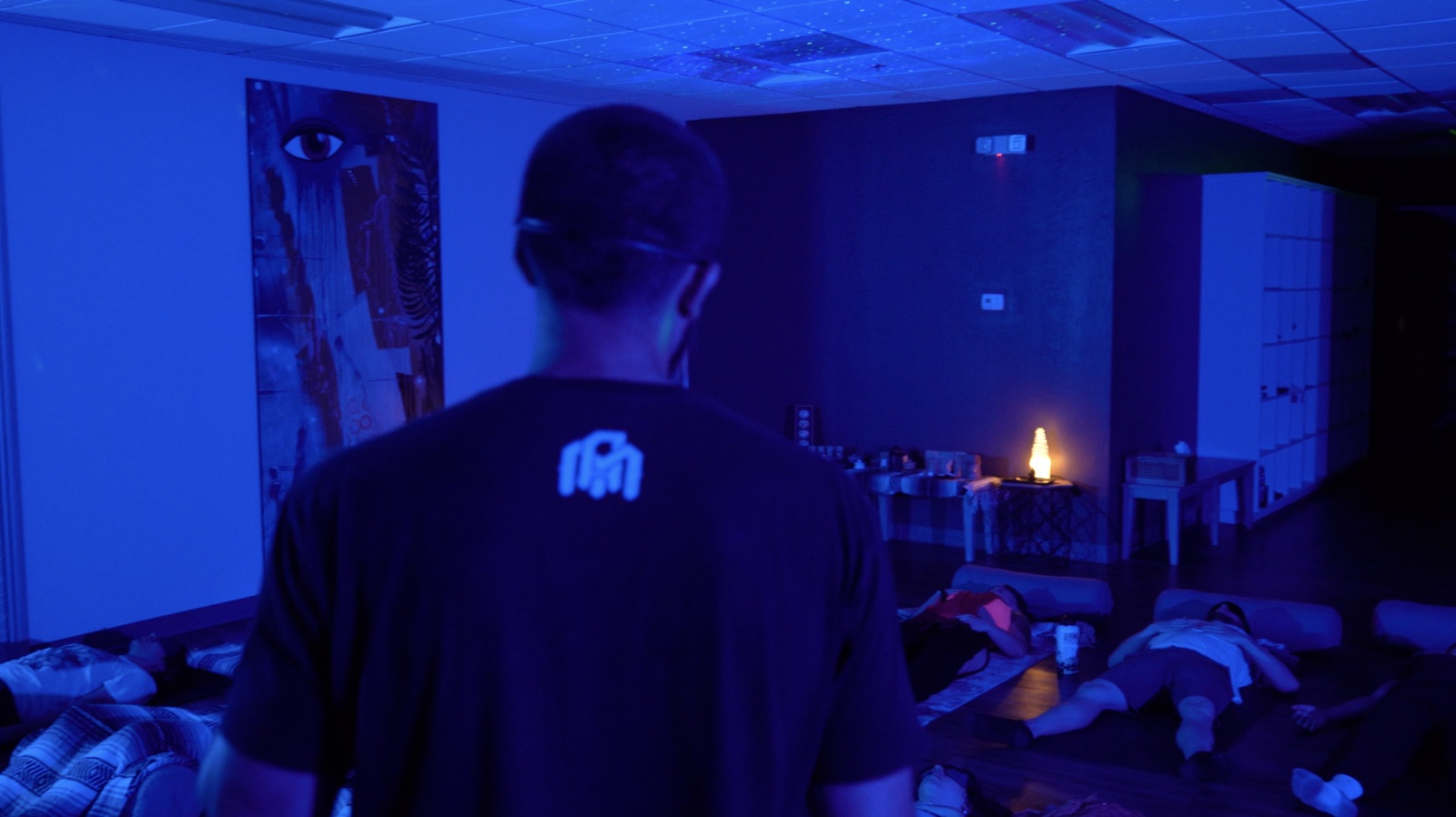
9D Breathwork is a guided practice that uses a multi-layered audio soundtrack delivered through over-ear headphones to lead a listener through a circular connected breathing session. It became popular in the UK around 2020 to 2022 and has since spread widely online. Sessions typically run 45 to 60 minutes and can be done at home alone.
It is worth knowing what this experience actually is, what it does well, and where it has real limits before you decide whether it is the right entry point for you. That is what this post covers.
We have facilitated over 1,000 sessions and trained facilitators across multiple modalities including SOMA Breath®, Somatiq, and Rebirthing Breathwork. We used this style of headphone-based practice in our own group sessions early on and made a deliberate choice to move away from them. Here is the full picture.
9D Breathwork is a pre-recorded, headphone-based experience that combines circular connected breathing with a complex auditory design: brainwave entrainment, subliminal affirmations, nature sounds, music composition, and guided voice coaching.
- Delivered via over-ear headphones with an eye mask for sensory immersion
- Popularized in the UK from approximately 2020 to 2022, now widely available online
- Sessions typically run 45 to 60 minutes with pre-session intention setting
- Low cost of entry, no facilitator required, accessible from home
- Best suited for beginners, solo practice, and remote users
9D Breathwork® is a registered trademark (U.S. Reg. No. 7,568,781) owned by 9D Breathwork Incorporated. Liquid Breathwork® is an independent training provider and is not affiliated with, endorsed by, sponsored by, or certified by any of them. Their programs are named here for identification and comparison only.
This modality is built around a proprietary multi-dimensional sound production technique. The "9D" refers to nine layers of audio mixed into a single track. Those layers typically include binaural beats, which use two slightly different frequencies to create a third perceived tone, isochronic tones, and solfeggio frequencies that are often associated with specific energetic states. On top of that, 8D spatial audio is used to move sound in three-dimensional space around the listener.
Above that audio foundation sits voice coaching that gives the breather real-time instruction, guided visualization, and emotional prompts. Music composition weaves through the entire experience to shape the emotional arc. The result is a highly immersive sensory environment that is designed to be felt, not just heard.
The breathing pattern at the core of these sessions is circular connected breathing: a continuous inhale-exhale cycle with no pause between breaths. This is the same fundamental technique used in Holotropic Breathwork®, Rebirthing Breathwork, and what we practice at Liquid Breathwork. The audio environment is what distinguishes this specific format from those other traditions.
Key Takeaways
- Accessible entry point: 9D Breathwork uses multi-layered audio, binaural beats, and spatial sound to provide a highly immersive, low-cost introduction to circular connected breathing that is ideal for beginners and solo home practice.
- Technology vs human connection: while the proprietary soundscapes effectively induce altered states and sensory engagement, the headphone-based format creates an audio bubble that isolates participants from the shared energetic resonance of a live group.
- Fixed vs responsive guidance: because 9D tracks are pre-recorded, they follow a rigid script that cannot adapt to the specific emotional or physiological needs of a room in real time, unlike live, facilitator-led sessions.
- Catharsis vs regulation: the modality often leans toward outward, cathartic vocalization, which offers a different therapeutic goal than the inward-focused, surrender-based approach found in traditional, non-headphone Breathwork practices.
How a 9D Session Works
A typical session follows a structured arc from intention through integration.
Before the session
The facilitator, either live or via pre-recorded audio, guides you through a short intention-setting moment. You are invited to bring a question, an intention, or simply an openness to whatever wants to move. Participants lie down, put on over-ear headphones, and cover their eyes with an eye mask to close off visual input and direct awareness inward.
The build phase
The audio track opens with music and the guide's voice establishing the breathing rhythm. You breathe in through the nose or via deliberate mouth breathing, depending on the specific track, maintain the connected circular pattern, and allow the soundscape to deepen around you. Over the first 15 to 20 minutes, the music intensifies and the brainwave entrainment layers begin to influence your nervous system.
The peak
Around the midpoint of the session, the soundscape reaches its most intense phase. The music is typically at its loudest and most emotionally evocative. The voice coaching often encourages vocalization, cathartic release, or expressive movement at this stage. Many participants experience tingling in the extremities, emotional waves, altered time perception, and strong physical sensations from the shift in blood CO2 levels created by the connected breathing pattern. During this high-intensity portion, the combination of sound and breath helps transition the brain into different brainwave states, which may facilitate deeper introspection and emotional processing.
Release and integration
The soundscape gradually softens, the voice guides you into a release and surrender, and the final 10 to 15 minutes are a quiet integration period where the music fades and you rest in stillness. Some tracks include gentle affirmations or closing guidance during this phase.
What 9D Breathwork Does Well
This methodology has real strengths, and we are not interested in dismissing them.
- Extremely accessible. You need headphones, a quiet space, and a device. No class, no commute, and no booking process. For people in remote areas or with limited schedules, this is a genuine advantage.
- Strong sensory immersion for beginners. If you have never done Breathwork before, the headphone environment gives your mind something concrete to hold onto while your body does its work. The audio is rich and engaging, which can help quiet the analytical mind more quickly than silence or simple music would, providing a useful tool for managing stress and anxiety in your daily life.
- Low cost of entry. A single session or a small library of tracks typically costs a fraction of what an in-person facilitated session costs. For someone who wants to explore Breathwork before committing to a live experience, it is a reasonable starting point.
- Consistency. A pre-recorded session delivers exactly the same experience every time. For people building a solo home practice, that consistency can be useful for steady personal growth over the long term.
Where 9D Breathwork Falls Short
Here is where we speak from direct experience, not theory. We used 9D-style headphone setups in our own group sessions and made a deliberate choice to stop. These are the reasons why.
Headphones compromise the audio quality of a real room
This sounds counterintuitive because 9D audio tracks are technically impressive. But headphones deliver sound to your ear canals. A high-quality speaker system in a dedicated Breathwork room delivers sound to your whole body. You feel bass frequencies in your chest and your seat. You feel the movement of air. You feel the physical dimension of the music in a way that earbuds and even premium over-ear headphones cannot replicate. This is a primary differentiator in somatic Breathwork, where the goal is to feel the vibration of the music within your own physiology to promote nervous system regulation.
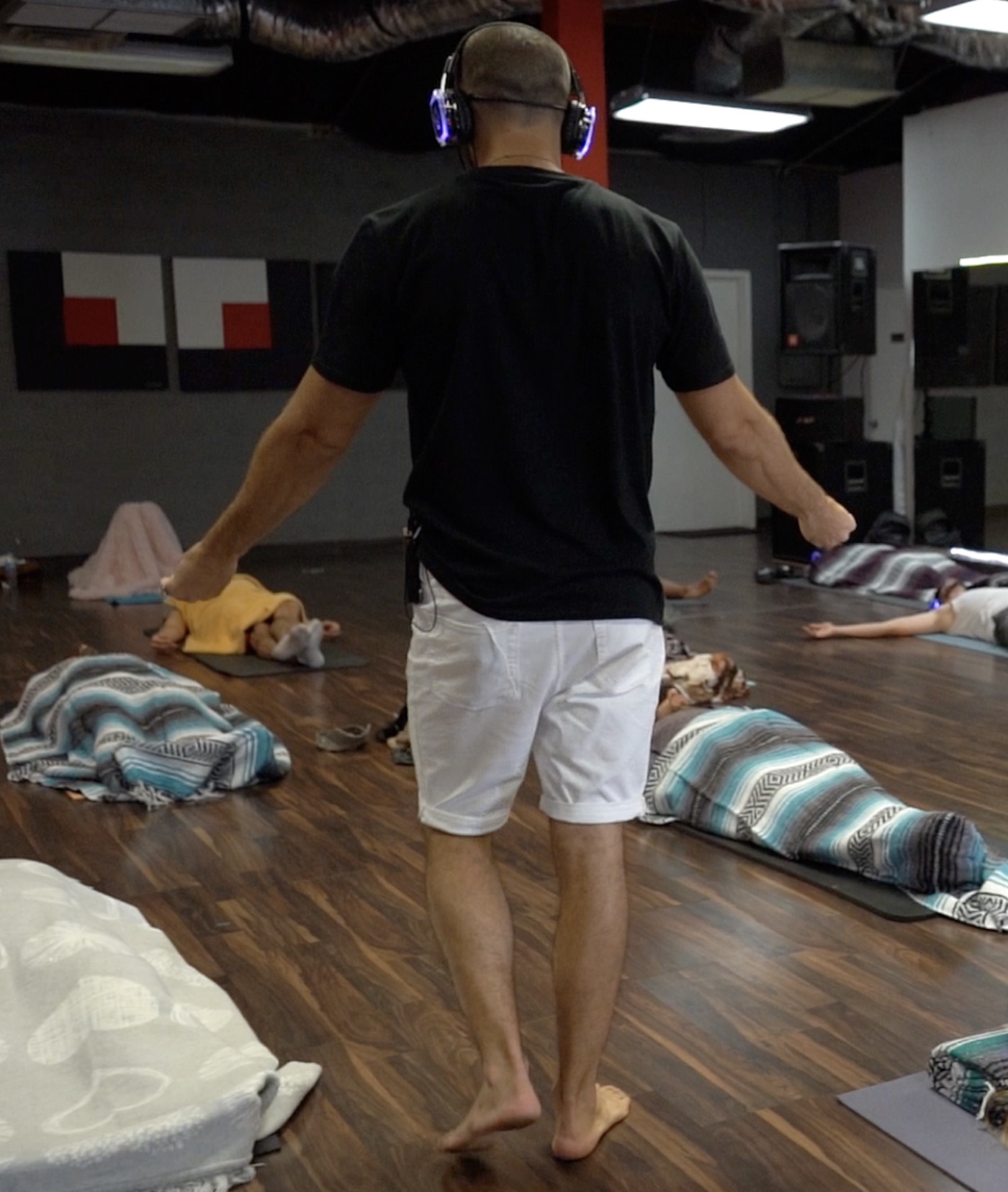
When we were running headphone-based sessions, we noticed the group consistently reported a flatter, more muted physical experience than when we switched to room speakers. The audio quality of a well-tuned speaker setup in a live room outperformed the headphone experience even though the 9D tracks were technically more complex.
The soundscape encourages outward expression over inward surrender
9D tracks are designed with an emotional build that often peaks with the guide encouraging yelling, screaming, or loud cathartic release. That style of expression is not inherently wrong. For some people it is exactly what they need at a particular point in their process.
But from our perspective, surrender and going deep require a quieter, more receptive nervous system. Outward expression, even cathartic expression, activates the sympathetic nervous system. It is mobilizing energy outward rather than allowing the body to complete its natural cycle of emotional regulation. In a group setting, it also creates a problem: one person's cathartic yelling becomes another person's distraction, pulling everyone else out of their inward focus and into a reactive state.
The most profound sessions we have facilitated have been the quiet ones. The room where fifteen people are moving through deep releases in near silence, each in their own internal landscape, collectively held by the group field, is a different category of experience than the room where people are encouraged to be loud.
Headphones isolate you from the shared room field
This is the trade-off that most people do not consider until they have experienced both. When a group of people breathes together in the same room without headphones, something happens that is genuinely difficult to explain in clinical terms. The nervous systems in the room begin to resonate with each other. You can feel the other breathers around you. The collective rhythm of fifteen people's breath creates a physical and energetic field that amplifies what is possible for each individual.
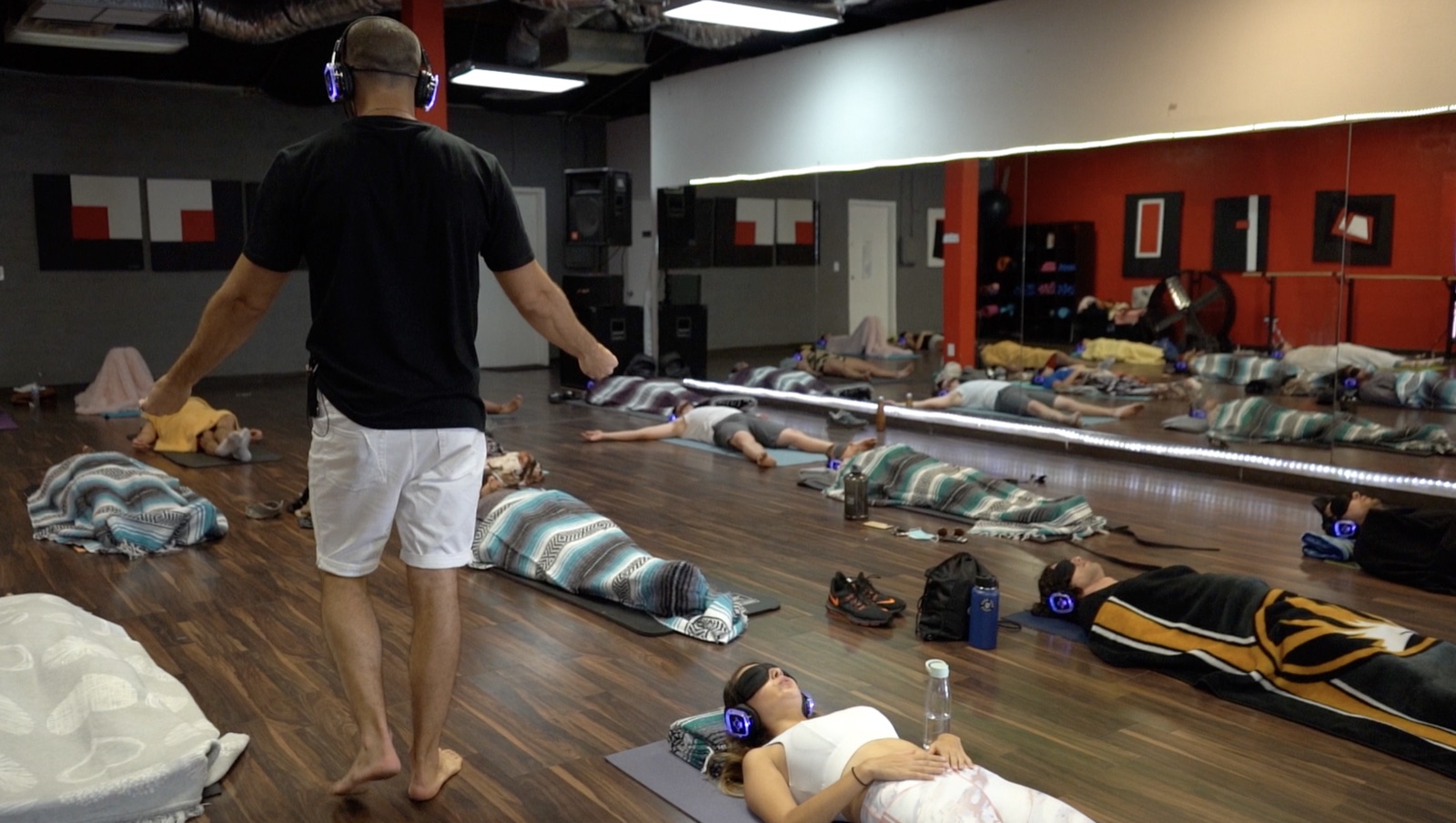
Headphones cut that off entirely. Each participant is in their own audio bubble, even when sitting next to another person doing the exact same track. The intimacy of the headphone experience is real and has value. But it caps how deep the collective field can go. It transforms a group session into a parallel solo experience happening in the same room.
Pre-recorded audio cannot read the room
A 9D session runs on a fixed timeline. The music builds and releases according to a pre-rendered script. It does not know that three people in the room are moving through something big and need two more minutes in the peak. It does not know that the energy today is lighter and faster, and the usual buildup is unnecessary. It cannot lower the volume during an unexpected moment of collective stillness because the room has found something on its own.
A live facilitator does all of those things. Reading the room, adjusting pacing and music volume, offering a verbal cue at the exact right moment, or saying nothing and letting the silence hold, because silence at the right moment is the most powerful cue of all. That responsiveness is the core of what a skilled facilitator offers and it is what a pre-recorded audio file structurally cannot do, regardless of how sophisticated the technology is.
9D Breathwork vs Liquid Breathwork: A Direct Comparison
The table below is meant to help you understand the actual trade-offs between the two formats, not to declare a winner. Both serve real purposes.
| Factor | 9D Breathwork | Liquid Breathwork |
|---|---|---|
| Format | Pre-recorded audio via headphones; can be done solo at home or in group with headphones | Live facilitated sessions in-person (Phoenix, AZ) or streaming online with live facilitator |
| Sound | Multi-layered binaural/spatial audio; highly produced; delivered to ears only | Curated music via room speakers; felt in the body, not just the ears; live DJ-style mixing |
| Facilitation | Pre-rendered script; consistent but fixed; no real-time adjustment | Live facilitator reads the room in real time; adjusts pacing, volume, and cues to match what is actually happening |
| Group field | Isolated; each participant in own audio bubble even when physically together | Shared sonic and energetic field; collective resonance from breathing together in the same room without headphones |
| Release style | Encourages outward, cathartic expression (vocalization, movement, yelling) | Surrender-based; inward, quiet release; body leads at its own pace without pressure to perform |
| Best for | Beginners, remote users, home practice, people who want high sensory stimulation | People seeking deep inward surrender, group resonance, skilled live facilitation, Phoenix Arizona locals |
| Typical price | $10 to $40 per track or subscription; some free versions available | Drop-in classes and membership options; see current schedule and pricing |
Who 9D Breathwork Is Genuinely a Good Fit For
We want to be straight about this because the honest answer serves you better than a sales pitch does. 9D Breathwork is a legitimately good option for some people as they begin their personal wellness path.
- Beginners who want to explore Breathwork before committing to a live session. The guided, structured format holds your hand through the experience in a way that allows a first-timer to start comfortably and independently.
- People in remote locations. If you are not near a skilled facilitator, a quality 9D track provides access to a Breathwork experience that supports emotional healing when you would otherwise be unable to attend a session.
- People who specifically want a loud cathartic release. Some people genuinely need to yell or express pent-up energy. If that is where you are, the style of 9D is designed to facilitate that type of output.
- People with mobility limitations or health conditions that make in-person sessions difficult. The at-home format removes many common barriers to entry.
- A complement to live facilitation. Using 9D tracks between live sessions as a home practice is a completely reasonable approach. The two formats do not have to compete and can work together.
Where we think 9D reaches its ceiling is when someone has been practicing for a while and starts to feel like something is missing. That something missing is often the group field, the live facilitation, and the profound sense of inner peace that a surrender-based approach creates. Many of our participants came to us after months or years of using 9D and other headphone-based formats, specifically because they wanted to go deeper and felt they had hit a wall with pre-recorded audio.
If you are in Phoenix or the surrounding area, our in-person classes are where we would invite you to experience the difference firsthand. If you are outside Arizona, our online courses and live streaming sessions give you access to live facilitation regardless of where you are. You can also read verified client experiences to hear from people who have made the transition from home practice to live facilitated work.
A Note for Aspiring Facilitators
If you are a professional Breathwork facilitator considering whether to incorporate 9D-style headphone sessions into your practice, our honest recommendation is to try it in your own sessions before committing to the format. Pay attention to what the group reports compared to non-headphone sessions. Pay attention to whether the cathartic style aligns with the container you want to hold.
Our guide to becoming a Breathwork facilitator covers training options, facilitation philosophy, and the key decisions you will face in building a practice. If you are looking for a training that goes deep on facilitation craft rather than format gimmicks, our Liquid Breathwork facilitator training is worth a look. We believe high-quality training should always prioritize trauma-informed care and foster greater self-awareness in the practitioner, so you can hold space safely and effectively regardless of the specific style of Breathwork you choose to facilitate.
Frequently Asked Questions
What does 9D stand for in 9D Breathwork?
The "9D" refers to nine dimensions of audio design layered into the soundtrack: binaural brain entrainment, isochronic brainwave tones, solfeggio frequencies, 8D spatial audio, Hemi-Sync style brainwave entrainment, bioacoustic sound effects, subliminal affirmations, nature soundscapes, and music composition. It is a marketing term describing the multi-layered sound technology used in the experience, rather than a clinical or scientific classification.
Does 9D Breathwork actually work?
Many people report meaningful experiences, including emotional releases, a sense of calm, and altered states of awareness. The combination of circular connected breathing and brainwave entrainment can produce real physiological shifts. By using elements of subliminal hypnotic suggestion, these tracks aim to influence the subconscious mind and improve cognitive coherence. Some listeners also report increased physical energy, often enhanced by the 432Hz harmonic tuning integrated into the soundscapes. Results vary based on audio quality, equipment, and individual receptivity. It works best as an accessible entry point for those who cannot access in-person sessions.
Is 9D Breathwork safe?
For most healthy adults, this practice is generally safe. The circular breathing pattern can cause light-headedness, tingling in the extremities, or strong emotional responses. People with cardiovascular conditions, epilepsy, a history of seizures, severe trauma or PTSD, or those who are pregnant should consult a doctor before trying any Breathwork modality. Because these sessions use pre-recorded audio with no live facilitator, there is no one to monitor your state or provide adjustments if the experience feels too intense.
How is 9D Breathwork different from Wim Hof or Holotropic Breathwork?
Wim Hof uses rapid breathing rounds paired with cold exposure to create an energizing, activating state. Holotropic Breathwork uses sustained hyperventilation to induce non-ordinary states of consciousness. This modality uses conscious connected breathing (similar in pattern to Holotropic) but pairs it with a highly produced multi-layered audio environment delivered through headphones. All three differ from Liquid Breathwork, which prioritizes nervous system regulation and inward quiet over peak experiences.
Can you do 9D Breathwork in person?
Yes. Some facilitators run group sessions where participants wear headphones in the same room and listen to the same pre-recorded track simultaneously. Because everyone is in their own audio bubble, the group dynamic operates differently than a live facilitated session. Each person is having a largely individual experience, even when others are physically present.
Why do some facilitators stop using headphones in group sessions?
Ryan McBurney used specialized headphones in group sessions early in his facilitation practice and moved away from them for two reasons. First, headphones reduce the audio quality of the live room. A well-tuned speaker system delivers sound to your entire body in a way that headphones cannot replicate. Second, headphones isolate each participant from the shared sonic field produced by the group. When fifteen people breathe together in the same room without headphones, you can feel the collective resonance. Headphones cut that off and turn a group session into a parallel solo experience.
What is circular connected breathing?
Circular connected breathing is a technique where you breathe continuously without pausing between the inhale and exhale, creating an unbroken rhythm. It is the core breathing pattern used in many modalities. The connected pattern keeps energy moving through the body and can produce physical sensations like tingling, warmth, or waves of emotion as the nervous system activates and the body begins to release stored tension.
Who is 9D Breathwork best suited for?
This is a strong option for beginners exploring Breathwork for the first time, people in remote locations without access to in-person facilitators, people who prefer solo home practice, and people drawn to a louder, more cathartic style of release. For people seeking deeper inward surrender, group resonance, and real-time facilitation that responds to what is happening in the room, in-person facilitated sessions offer a different level of depth.
Experience Real-Room Breathwork in Phoenix
We hold live Breathwork classes in Phoenix every week. No headphones, no script, no fixed timeline. Just a skilled facilitator, a room full of people breathing together, and music you can feel in your chest. If you are local, come try it once and see what you notice.
Not in Arizona? We offer live-facilitated online sessions too. Drop your email below and we will send you the next available session times and a free intro guide to getting started.